Ngaba UThixo Utshintshe Kwiminyaka Yeminyaka? Hayi, IBhayibhile ithi uThixo uyafana, izolo, namhlanje, nangonaphakade. Ngoko ke, Imbono kaThixo ngoogqirha isafana. Abantu ngabona batshintshayo. Ngamaxesha athile, they even change the words in the Bible so that the Word fits into their lives and fulfill their needs or shortcomings. Because of that their view on certain matters changed and often are not agreeing with the words and will of God. Let’s look at what the Bible says about doctors and medicine and whether God blessed doctors or not.
I imfazwe between the two kingdoms
It is important to realize that there is a spiritual war between the Kingdom of God (apho uYesu Kristu nguKumkani) nobukumkani bobumnyama (ubukumkani bukaMtyholi (Owu. UYohane 12:31; 14:30; Kwabase-Efese 5:8; 6:10-18; KwabaseKolose 1:13-14; ISityhilelo 12:7-9)).
God created man and gave the rulership over the earth to man. Man lived in communion with God and was placed under God, until man chose to believe and obey the words of the serpent and sinned.
Through the fall the spirit in man died and came under the authority of death. The devil became the ruler of the world and the father of fallen man. All the people that were born of Adam’s seed would come under his authority.
But through the redemptive work of Jesus Christ on the cross, through His blood, kunye novuko lwabafileyo, fallen man was given the opportunity to be ubuyiselwe (ukuphiliswa) kwindawo yakhe kwaye Ukuxolelanisa noThixo by faith and regeneration in Christ and become a new creation.
The new creation is placed above the devil and angels and has been given all power and authority through -and in Christ Jesus.
When you believed and gave your life to Jesus Christ, and repented and became born again in Him, ubu sihlangulwe kumandla obumnyama and translated into the Kingdom of God (KwabaseKolose 1:13-14).
 Phambi kokuba uzalwe ngokutsha, you were the old creation that was bound by your sinful nature and served your old master and father the devil, who blinded you with his lies and let you walk in darkness.
But when you believed and Jesus Christ became your Savior and you made Him the Lord of your life, you were transferred to another Kingdom with a new Father, and a new Master, Who lets you walk in the light.
In Christ you have inherited eternal life.
The redeemed man versus the unredeemed man
The unredeemed man; indalo endala (umntu owileyo) is carnal and still under the devil’s authority and bound to sin and death. But the redeemed man; indalo entsha (Indoda entsha) is seated in Christ and has all authority in Christ over the devil and angels, because Jesus Christ defeated the devil, and is bound to righteousness and (ngonaphakade) ubomi.
Ngoku, ngako konke oku engqondweni, let’s look at the origin of sickness and diseases, kunye nokuphilisa, and if medical science and doctors, ezibhedlele, iikhemesti, njl. are from God or not.
If God blessed doctors,
why does God call Himself Jehovah Rapha?
KwiTestamente eNdala, we do not read a lot about diseases. If someone became ill, and went to God, then God healed that person. The healing took place when God’s people returned to God and kept the Law of Moses.
It often happened, that when people became abangamthobeliyo uThixo, they became ill. We read this among others, in Numbers, the Book of Kings, and Chronicles.
Wathi uThixo, that if we Gcina imiyalelo yakhe He will take away all sickness and disease (o.k. iEksodus 23:25 nakwiDuteronomi 17:15).
What does the Bible say about doctors in the Old Covenant?
ukumkani uAsa
In the Old Covenant we read about doctors in the life of King Asa (2 YeziKronike 15). King Asa was obedient to God and kept His laws and commandments, ngaphandle kweendawo eziphakamileyo. King Asa did not take the high places away but left them.
King Asa trusted the Lord and relied on Him and God was with King Asa. God gave nations into his might until King Asa no longer relied on God and went his own way.
The heart of King Asa did not go out to God anymore. God was no longer his source. God was not his Jehovah Nissi, and his Jehovah Jireh anymore. King Asa denied God by replacing God with another king, an earthly king of Syria, a human.
 UHanani, who was a prophet of God, went to Asa to warn him. But King Asa did not listen to his words and didn’t repent.
Emva kwexesha elithile, King Asa became ill.
Nangona kunjalo, King Asa did not show any mercy to God. He did not repent of his ways, engazange amfune noThixo
King Asa called for the physicians (translation from Hebrew Rapha). In our time we call these physicians, ogqirha. This was an abomination to God.
These physicians couldn’t heal King Asa and King Asa died.
King Asa went to the physicians for healing
UAsa ukumkani wawathabatha onke amaYuda; awasusa amatye eRama, nemithi yayo, awayesakha ngayo uBhahesha; wakha ngayo iGebha neMizpa. Ngelo xesha uHanani, imboni, weza kuAsa ukumkani wakwaYuda, Yathi kuye, ngokuba wayama kukumkani wakwa-Aram;, and not relied on the Lord thy God, ngenxa yoko isaba esandleni sakho impi yokumkani wakwa-Aram. AmaTiyopiya namaLubhi ayengengomkhosi omkhulu na?, beneenqwelo zokulwa nabamahashe abaninzi kunene? okwangoku, ngokuba wayama ngoYehova, wabanikela esandleni sakho.
“Yet in his disease, he sought not to the Lord, ndiya kumagqirha”
For the eyes of the Lord run to and fro throughout the whole earth, to shew Himself strong in the behalf of them whose heart is perfect toward Him. Wenze ubudenge ngale nto: ke ngoko ukususela ngoku uya kuba neemfazwe. UAsa wayiqumbela imboni leyo, wamfaka entolongweni; ngokuba ebevutha ngumsindo ngenxa yale nto. UAsa wabacinezela abantu kwangelo xesha. Kwaye, khangela, izenzo zika-Asa, eyokuqala neyokugqibela, khangela, zibhaliwe encwadini yookumkani bakwaYuda nabakwaSirayeli.
UAsa ngomnyaka wamashumi omathathu anesithoba wobukumkani bakhe, waba nesifo ezinyaweni zakhe, sada saba sikhulu kakhulu isifo sakhe: noko esifeni sakhe akamquqelanga uYehova, ndiya kumagqirha.
UAsa walala kooyise, wafa ngomnyaka wamashumi omane anamnye wobukumkani bakhe. Bamngcwabela kwelakhe ingcwaba, awayezenzele emzini kaDavide, wamlalisa elukhukweni oluzele livumba elimnandi, neentlobo ngeentlobo zobulawu, obulungiselwe ngabaqholi.’ ubugcisa: bamenzela utshiso olukhulu kunene. (2 YeziKronike 16:6-14).
What does Jehovah Rapha mean?
Jehovah Rapha means God is our Healer, and no one else is. There are only two kingdoms, we don’t have any more options.
When we look at the story of King Asa; we read, that he did not seek God, who is Jehovah Rapha, ekuguleni kwakhe. Ngoko ke, he didn’t seek the Kingdom of God. Kunoko, King Asa sought the other kingdom, obu bubukumkani bobumnyama. King Asa sought help from the devil, who is the ruler of the other kingdom.
The devil inspired the physicians and gave them the knowledge and he worked through the hands of these physicians (ogqirha).
The physicians (ogqirha) were not from God but from the devil. If King Asa repented of his deeds and turned back to God and had sought God for healing in his illness instead of seeking the doctors (ogqirha) yokuphilisa, God would have healed King Asa, Ngokuqinisekile. But King Asa didn’t do that.
All the visible things have its origin in the spiritual realm
God created everything by His Word and the power of the Holy Spirit. Everything you see in the natural has its origin in the spiritual.
The same applies to sickness and disease.
The origin of sickness and disease
Sickness and disease are the results of demonic spirits (ummandla womoya) operating in the flesh (Indawo yendalo). The sickness and diseases, which are visible and measurable in the body are manifestations of the damage that has been caused by demonic spirits.
Umzekelo, deafness and dumbness is a manifestations of a deaf and dumb spirit, a tumor is a manifestation of a cancer demon and forgetfulness is the manifestation of an Alzheimer’s demon.
 As long as you don’t acknowledge sickness and disease coming from demonic spirits (demons manifesting themselves in a body or a soul), and if you don’t acknowledge that the origin of sickness is in the spiritual realm, but instead consider sickness and diseases as a natural bodily reaction of a natural cause, you will never be able to heal people in the Name and power of Jesus Christ.
You shall not be able to walk in faith and lay hands on sick people as Jesus did.
You must understand that the devil’s ultimate goal is to destroy people. He commissioned his fallen angels (demons or evil spirits) to do everything they can to accomplish his goal.
The devil sends his messengers to people with the commandment to seduce them and then steal, bulala, and destroy the people. The demon can only return to his master when he accomplishes his mission.
Where do doctors come from and what is the origin of medical science?
Let’s have a look at the doctors and the way of healing in ancient cultures and the roots of modern science:
- AmaHebhere ayenemithetho yawo yezempilo anikwe nguThixo, UYehova Rapha (Book of Leviticus)
- Iyeza laseSumeri (4000 Bc) yayisekelwe ekuvumiseni ngeenkwenkwezi.
- iyeza laseYiputa (1500 Bc) ababingeleli, who were initiated in medical knowledge and many specialists in one particular disease.
- iyeza lasePersi (1000 Bc) showed an affinity with the Hebrew health laws and underlies the Islamic health rules.
- Greek culture developed medicine in 3000 Bc. Medicine became a science based on research. Kule nzululwazi, views were developed based on the right balance between healthy and unhealthy. This could be realized by a proper way of living and a healthy environment. A well-known doctor was Alcmaeon (500 Bc). The medical school of Kos had brought forth the father of Western medicine: Hippocrates (460-377 Bc). Hippocrates had a profound understanding of human suffering and put the doctors in the service of the patients. UHippocrates wayengugqirha nesazinzulu esinobuchule. Nguye, who is usually credited for applying humorism, which is also called the doctrine of the four temperaments as a medical theory. This theory holds that the human body is filled with four basic substances, ezibizwa ngokuba ziintlekisa, ezihambelanayo xa umntu esempilweni. Zonke izifo kunye nokukhubazeka kucingelwa ukuba zibangelwa kukugqithisa okanye ukusilela kwenye yezi hlekisayo zine. These deficits could be caused by vapors that are inhaled or absorbed by the body. The four humors are black bile, inyongo etyheli, iphlegm, kunye negazi. During the 17th century, isayensi yezonyango esekelwe kuphando lwezenzululwazi yahamba ngophuhliso lwenguqu.
This is just a very short summary of the origin of medical science. But it shows that doctors and medicine go way back. Doctors already existed before Jesus came to the earth.
Remember the story of King Asa, who also turned to a medicine man. Every group of people (inkcubeko) had, kwaye isekhona, its own healers and its own way of healing people. The people of Israel had Jehovah Rapha (uThixo), Ngubani owabaphilisayo.
The Oath of Hippocrates
Before doctors can practice medicine, they must swear by an oath. The oath originally came from the oath of Hippocrates. We can distinguish four parts in the oath of Hippocrates:
- A diversity of gods are called as a witness.
- Isivumelwano apho ugqirha omncinci ufunga ukuthobela imimiselo yombutho weengcali. Kwesi sivumelwano kubhalwe imigaqo yobudlelwane obuhle.
- A summary of ethical codes.
- A declaration where the reputation of the doctor depends upon his loyalty to the oath.
What is the original oath of Hippocrates?
Ndifunga uApollo, ixhwele, Asclepius, Hygieia, kunye nePanacea, kwaye ndinikela ubungqina kubo bonke oothixo, zonke izithixokazi, ukugcina ngokokwam amandla nangokwengqiqo yam, esi Sifungo nesivumelwano esilandelayo:
Ukuqwalasela othandekayo kum, njengabazali bam, lowo wandifundisa obu bugcisa; ukuhlala kunye naye kunye, ukuba kuyafuneka, ukwabelana naye ngezinto zam; Ukubajonga abantwana bakhe njengabazalwana bam, ukubafundisa obu bugcisa; kwaye oko ngemfundiso yam, Ndiya kubadlulisela ulwazi lobugcisa koonyana bam, nakubantwana bomfundisi wam, nakubafundi ababotshelelwe kwisifungo nesifungo ngokwemithetho yezonyango, and no others.
Ndiza kumisela iirejimeni zokulunga kwezigulana zam ngokwamandla am kunye nesigwebo sam kwaye ndingaze ndenze umonakalo nakubani na. Andiyi kunika iyeza elibulalayo nakubani na ukuba libuzwa, okanye ucebise ngesiluleko esinjalo; kwaye ngokufanayo andizukumnika umfazi ipessary ukuze akhuphe isisu. Kodwa ndiya kubugcina ubunyulu bobomi bam nobugcisa bam. Andiyi kugawula ngenxa yamatye, nakwizigulane ezibonakalisa kuzo eso sifo; Ndiza kuluyeka olu tyando ukuba lwenziwe ngoogqirha, iingcali kobu bugcisa. Kuyo yonke indlu endiya kuyo ndiza kungena kuphela ngenxa yezigulane zam, ukuzigcina kude kuko konke ukwenza okubi ngabom kunye nako konke ukuhenda kwaye ngakumbi kulonwabo lothando nabasetyhini okanye amadoda, nokuba bakhululekile okanye bangamakhoboka. Konke okunokuthi kufike kulwazi lwam ekusebenziseni umsebenzi wam okanye kurhwebo lwemihla ngemihla namadoda, engafanelanga ukuba isasazwe, Ndiya kuyifihla, andiyi kutyhila.
Ukuba ndithe ndasigcina ngokunyanisekileyo esi sifungo, ndinga ndingabunandipha ubomi bam kwaye ndiqhelisele ubugcisa bam, ihlonitshwa ngabantu bonke nangamaxesha onke; kodwa ukuba ndiyaphambuka kuyo okanye ndiyaphula, yanga umva bubomi bam.
Sithini isifungo esihlaziyiweyo sikaHippocrates?
E-US, kunye namanye amazwe amaninzi isifungo sokuqala siye sahlaziywa kwaye umzekelo wesinye ulandelayo:
Ndithembisa ngokunyanisekileyo ukuba ndiya kunceda uluntu kangangoko ndinako—ukunyamekela abagulayo, ukukhuthaza impilo entle, kunye nokunciphisa intlungu kunye nokubandezeleka.
Ndiyaqonda ukuba ukwenza amayeza linyhweba eliza nalo uxanduva olukhulu kwaye andisayi kusisebenzisa kakubi isikhundla sam. I will practice medicine with integrity, ukuthobeka, ukunyaniseka, novelwano—ukusebenza noogqirha endisebenza nabo kunye nabanye endisebenza nabo ukuze ndihlangabezane neemfuno zabaguli bam.
I shall never intentionally do or administer anything to the overall harm of my patients. I will not permit considerations of gender, uhlanga, unqulo, ukuzimanya nezopolitiko, Ukwaziswa ngezesondo, ubuzwe, okanye ukuma kwentlalo ukuphembelela umsebenzi wam wokhathalelo. I will oppose policies in breach of human rights and will not participate in them. I will strive to change laws that are contrary to my profession’s ethics and will work towards a fairer distribution of health resources. I will assist my patients to make informed decisions that coincide with their own values and beliefs and will uphold patient confidentiality.
Ndiya kuqaphela imida yolwazi lwam kwaye ndifune ukugcina kunye nokwandisa ukuqonda kwam kunye nezakhono ebomini bam bonke bomsebenzi. Ndiyakuvuma kwaye ndizame ukulungisa iimpazamo zam kwaye ndifikelele ngokunyanisekileyo kwaye ndiphendule kwezo zabanye. I will seek to promote the advancement of medical knowledge through teaching and research. I make this declaration solemnly, ngokukhululekileyo, naphezu kozuko lwam.
Singagqiba, that modern Western medicine is based upon Greek philosophy and has become a science. This medical science has been developed over the years, due to scientific research and medical science is still developing.
What about pharmacies and medical symbols?
Kwintsomi yamandulo yamaGrike, Asclepius is considered the god of medicine. Asclepius was the son of Apollo and Coronis. Asclepius shared, with Apollo, the epithet Paean (“uMphilisi”). UApollo wathwala umntwana uAsclepius (which he took from the womb of Coronis, unina ka-Asclepius) kwicentaur Chiron, owakhulisa uAsclepius waza wamfundisa ubugcisa bezonyango.
I-Asclepius imele inkalo yokuphilisa yobugcisa bezonyango. The daughters of Asclepius are:
- I-hygiene (“Ucoceko”, uthixokazi/ubuntu bempilo, ucoceko, kunye nococeko),
- UYesu (uthixokazi wokuchacha ekuguleni),
- Lit (uthixokazi wenkqubo yokuphilisa),
- Aglaea/Aegle (uthixokazi wobuhle, ubukhazikhazi, uzuko, ubungangamsha, nokuhomba),
- I-panacea (uthixokazi wonyango lwendalo yonke).
Asclepius was associated with the Roman god Vediovis. Zeus killed Asclepius with a thunderbolt, because he raised Hippolytus from the dead and accepted gold for it.
Other myths say, ukuba uAsclepius wabulawa, because after bringing people back from the dead, Hades thought, that no more dead spirits would come to the underworld, therefore he asked his brother Zeus to remove him. Oku kwamcaphukisa uApolo, owathi naye wabulala iCyclopes, owayenzela uZeyus iindudumo
Intonga ye-Asclepius, umsimelelo wenyoka, is still the symbol of medicine today. This symbol (intonga ye-Asclepius) is not only used by doctors, kodwa nakwii-pharmacy, ngakumbi isimboli esinesitya, from which the serpent is drinking from.
Esi sitya sisimboli sococeko, intombi ka-Asclepius kunye nesithixokazi sempilo.
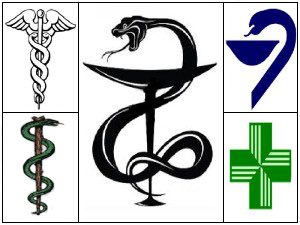
We all recognize these symbols above, but do you also know their meaning and their origin?
Does the medical symbol represent the serpent of brass on the pole
The symbol of the rod does not represent the serpent of brass on the pole, which Moses made and was a foreshadowing of Jesus’ ukufa emnqamlezweni, as so many Christians think. (Funda kwakhona: Why was the serpent of brass a foreshadowing of the Jesus’ ukufa emnqamlezweni).
Astrology symbol Caduceus
The staff in the picture in the upper left corner is an old astrology symbol and is also called ‘Caduceus’. Intonga enamaphiko yayithwalwe sisithixo samaGrike uHermes (kwanothixo wamaRoma uMercury).
The snakes represent dualism, nto leyo ekugqibeleni eya kubangela imvisiswano.
Intonga ye-Asclepius
In the picture on the bottom left, sibona intonga ka-Asclepius, which is also called Aesculapius staff. Le ntonga ye-Asclepius yayithwalwe sisithixo samaGrike uAsclepius, uthixo wamayeza nokuphilisa.
Inyoka evalelweyo ibizwa ngokuba yiEpidaurus kwaye yayisetyenziswa kwizithethe zokuphilisa (Funda kwakhona: Itrone kaSathana).
The bowl of Hygieia
Isitya simele i-Hygieia, the goddess of health and the daughter of Asclepius. The serpent is being fed out of the bowl (Picture in the middle and upper right). So Hygieia feeds the serpent.
The green cross
The green cross originates from Greece and is a symbol of the union of pharmacies.
Siyabona ukuba le mifuziselo, which are still used today, represent doctors, ezibhedlele, iikhemesti, njl., and have their origin in Greek mythology. The symbols represent the Greek gods and have nothing to do with the Almighty God; i UMdali wezulu nomhlaba.
The devil is not a creator but an imitator. The devil copies everything from God. Why does the devil do that? Because the devil wants to be like God.
The devil wants to be the god of the people and want them to worship him. Therefore the devil created and still creates substitutes for God, ukuze abantu bangamdingi uThixo kodwa banokwenza yonke into ngokwabo.
Ngaba uYesu wabaphilisa bonke abagulayo?
- Ngaba uYesu wakha wathumela umntu kugqirha okanye kugqirha? Ukuba kunjalo, ibhalwe phi?
- Ngaba uYesu wayalela abafundi bakhe ukuba base abantu abagulayo kumagqirha okanye koogqirha?
- Ngaba uYesu wakha wayalela abagulayo ukuba baye koogqirha okanye kumagqirha, xa Wayesiya kuBawo?
- ULuka wayengugqirha, kodwa wayengugqirha kummandla wemvelo kummandla womoya? Kaloku uYesu wayezibiza ngokuba nguGqirha kodwa uYesu wayengenguye ugqirha.
- Ukuba ngenene uLuka ebeya kuba ngugqirha, UYesu wabathumela phi abagulayo kuLuka? Okanye bathumela nini abapostile abagulayo kuLuka?
- Ukuba uLuka wayengugqirha, ukhe wawenza nini umsebenzi wakhe? Ibhalwe phi?
- Ngaba uThixo wathumela abantu abagulayo kumagqirha, amayeza okanye oogqirha kwiTestamente eNdala?
- Aphi amagqirha, who are the followers and disciples of Hippocrates, mentioned in the New Testament?
Jesus healed all who were sick and oppressed by the devil. He was a man, who knew His authority and knew where sickness came from.
The promise of healing in the Bible
Inene, uzithwele umvandedwa wethu, wazithwala iintsizi zethu: kanti besiba ubethwe, obethwa nguThixo, and afflicted. But He was wounded for our transgressions, Watyunyuzwa ngenxa yezenzo zethu ezigwenxa: ubetho lokuba sibe noxolo thina lube phezu kwakhe; kwaye ngemivumbo yaKhe siphilisiwe (uIsaya 53:4-5)
Umntu oza kubazongela izono zethu emzimbeni wakhe emthini, ukuba thina, Ukufa izono, kufuneka uphile ubulungisa: Imivumbo yakhe naphilisiwe (1 UPetros 2:24)
Jesus took all sickness and sin upon Him and carried our sorrows. All sickness and diseases in the body and in the soul are paid on the whipping post and on the cross.
Before the crucifixion, Jesus bore all our sickness and disease in His flesh at the whipping post, and on the cross the Father laid all the sins of fallen man upon Him.
UPeter wabhala, that ‘by His stripes, you were healed’. Ngamanye amazwi, the words in Isaiah 53:4-5 were fulfilled at the whipping post, apho uYesu wahlawula ixabiso loluntu oluwileyo. Ukuphilisa sele kwenziwe.
Ayekho na amagqirha kuYesu’ ixesha?
Ewe, kuYesu’ ixesha kwakukho oogqirha (ogqirha). Hippocrates, othathwa ngokuba nguyise kunye nomseki wenzululwazi yezonyango ehlala kuyo 460-377 Bc. Abafundi bakaHippocrates (ababingeleli etempileni ka-Asclepius) bafumana ulwazi lwezonyango kuye baza bafundisa abafundi babo ulwazi lwabo lwezonyango kwi itempile ka-Asclepius.
Umfazi onethombo legazi
KuMarko 5:25-27 sifunda ngomfazi owayenethombo legazi, eya kumagqirha (ogqirha).
Kwaye umfazi othile, elalinethombo legazi iminyaka elishumi elinamibini, Wayeve ubunzima obuninzi kumagqirha amaninzi, wachitha yonke into abenayo, kwaye akukho nto ibhetele, koko kwaba kubi ngakumbi, Wathi akuva ngoYesu, weza ngoshicilelo ngasemva, wachukumisa ingubo yakhe.
 Kuba wathi, Ukuba ndingabamba kodwa iimpahla zakhe, Ndiyakuphila. Watsha kwaoko umthombo wegazi layo; yeva emzimbeni wayo ukuba iphilisiwe kweso sibetho (Phawula 5:25-29).
Ibhinqa, ababenethombo legazi, wachitha imali eninzi koogqirha abaninzi. Wayechithe yonke into awayenayo koogqirha.
Kodwa ngaba uye waba ngcono? Hayi, njengokuba ngenyaniso, imeko yakhe yaba mbi ngakumbi!
Kanjalo, imeko yakhe ayizange ibe bhetele, yaye akazange aphile, ngokuba amagqirha (ogqirha) khupha kumthombo kasathana; umthombo wokufa.
Xa usebenzisa iyeza, awukhululekanga, kodwa ebukhobokeni. Xa usiya kunyango, awukhululekanga, kodwa ebukhobokeni kwaye ekugqibeleni, kuya kuba kubi ngakumbi. Kaloku usathana akanikezeli nto ngesihle, usathana uhlala efuna into ngembuyekezo. Khumbula, umsebenzi kasathana kukuba, bulala, atshabalalise, angabuniki ubomi (UYohane 10:10).
UYesu uthembisa ubomi benkululeko, hayi ebukhobokeni
Lumka hleze nawuphi na umntu ukonakalisa intanda-bulumko kunye nenkohliso, Emva kwesiko lamadoda, Emva korhafi lwehlabathi, hayi emva kukaKristu (KwabaseKolose 2:8).
UPawulos wayesele ebalumkisile abangcwele kwabaseKolose 2:4-15 ngenxa yobulumko basemhlabeni; ulwazi lomntu, Bubudenge kuThixo:
 Ngala maxesha, sele siyiqhelile kakhulu inkqubo yehlabathi, ukuba asiwuboni umahluko kwakhona phakathi kwento evela kuThixo nephuma kumtyholi.
Sithatha inkqubo yokhathalelo lwezonyango; ogqirha, ezibhedlele, Iingcali zonyango, Iingcali zengqondo, njl. ngokuyinyani kwaye uyithathe njengesiqhelo. Yinxalenye yobomi bethu.
Amanye amaKristu ade athi, ukuba oogqirha basikelelwe abo, abo bathunywe nguThixo. Kulungile, obo bobona buxoki bukhulu!
Xa uzalwa ngokutsha kwaye uhlaziye ingqondo yakho ngelizwi likaThixo, naxa nifuna izinto zaphezulu, zingezizo ezasemhlabeni, uya kuvuleka amehlo akho, uqonde, kwaye namava inyaniso kaThixo.
Niya kubuqonda ubuxoki boMtyholi, apho uhlala khona(d) iminyaka emininzi. Niya kucalula oomoya noomoya, nicalule okulungileyo nokubi;.
Hlaziya ingqondo yakho kwaye ufumane ingqondo kaKristu
Ingqondo yakho yenyama, elicinga njengehlabathi, ithi: ukuba uyagula okanye uziva uqaqanjelwa uya kwagqirha okanye ukuba udandathekile, uya ku a isazi ngengqondo okanye ukuba ufumana ubuhlungu emqolo wakho uya ku a ingcali yezomzimba, njl., Ke ngoko kufuneka uhlaziye ingqondo yakho yenyama ngelizwi likaThixo ukuze lihambelane nentando kaThixo (Funda kwakhona: Kutheni kufuneka uhlaziye ingqondo yakho?).
Zonke ezo nqaba, okwakhelwe ezingqondweni zenu makutshatyalaliswe. Ekuphela kwendlela yokubatshabalalisa kungeLizwi likaThixo.
Ndingathanda ukukukhuthaza, ukufunda kunye nokufunda iZibhalo ezikhankanywe kule posi yebhlog kwaye uzihlolele yona. Khangela kuyo kwaye ufumanise inyaniso kaThixo.
Lixesha lokuba abangcwele bavuke babuyele kuThixo. Lixesha lokuba simamkele kuzo zonke iindlela zethu, hayi nje abambalwa. Makabe nguYehova wethu uRafa kwakhona.
‘Yibani yityuwa yehlabathi’